
Reviewed · EASTER ISLAND TOURS
Rapa Nui Stargazing
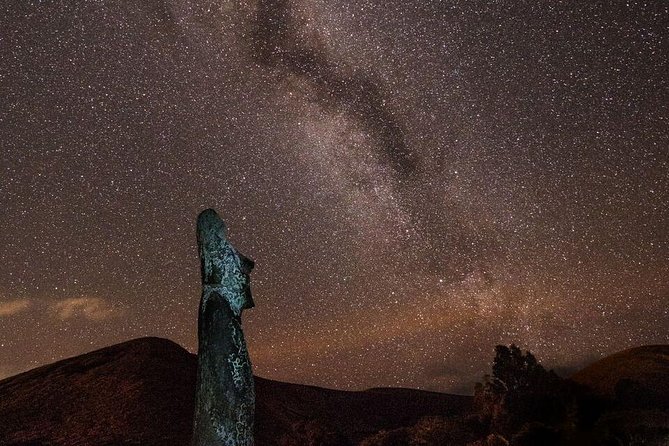
Rapa Nui Stargazing takes you far from Hanga Roa’s lights to see the southern sky as the island’s early Polynesian navigators once did. The night combines telescopes, star stories, and special nighttime access near Ahu Nau at Anakena Beach, followed by photos beside the moai.
I like the small maximum of 12 people, which makes telescope viewing and questions much easier. I also like the cultural thread: guides such as Mark connect planets and constellations with Polynesian ocean navigation, so this is more than a silent look upward. The main drawback is weather uncertainty. Cancellations can come close to departure, and a clear sky in town may not mean calm, usable conditions near Anakena.
Key points
- Remote stargazing site: Telescopes are set up away from town lights before the group continues to Anakena.
- Polynesian navigation story: The guide explains how stars helped Polynesian voyagers cross the Pacific.
- Night access at Ahu Nau: The tour ends with a moai photo session at Anakena Beach.
- Small group format: The maximum is 12 people, with a more personal feel than a large bus tour.
- Hot chocolate and local cake: A warm drink and cake are served during the night.
- Weather and moon matter: Strong wind, cloud, rain, and bright moonlight can cancel the outing.
What Rapa Nui Stargazing actually offers
This is a three-and-a-half-hour night outing built around two settings. First, you leave Hanga Roa for a dark, remote place where the telescopes can work properly. Then you continue to Anakena Beach, where you have special nighttime access to Ahu Nau and finish with photographs of you and the moai under the stars.
The astronomy is the main event, but the explanation gives the night its sense of place. Rapa Nui is not simply an isolated speck in the Pacific. Its people were part of a wider Polynesian world, and the guides explain how voyagers used the sky to find islands across open ocean. That context helps you see the constellations as practical tools, not just pretty points of light.
The experience is led by a local driver-guide, with live commentary during the ride. Mark is named in several accounts, and Tuhii is praised for the hot chocolate. The exact guide can vary, but you should expect a local team rather than a remote astronomy lecture delivered without connection to the island.
More Stargazing Tours in Easter Island:
- Easter Island: Rapa Nui Stargazing Tour
★ 4.8 · 16 reviews - San Pedro de Atacama: Etno-Stargazing Tour with Transfer
★ 4.8 · 629 reviews - San Pedro de Atacama: Stargazing Experience
★ 4.7 · 489 reviews
Meeting at Katipare Library in Hanga Roa
There is no hotel pickup. You meet in front of the Centro Lector Katipare, also called Katipare Library, in Hanga Roa. The published meeting time is 8:00 p.m., with seasonal changes noted in the operating information.
The timing needs a little attention. One notice gives 8:00 p.m. in summer and 7:30 p.m. in winter, while another says September through April departures may begin between 8:30 and 9:00 p.m. Contact the operator shortly before the outing and confirm the exact meeting time for your date. On a small island, missing the group is a poor way to begin the evening.
The ride out is part of the experience. Your driver-guide provides live commentary, and the group travels together to a place with far less artificial light. At the end, hotel drop-off is included, which is useful at an hour when walking around Hanga Roa is less convenient.
Bring a jacket or long-sleeve layer. Even after a warm day, the open night can feel chilly, especially while you are standing still beside a telescope. A flashlight or headlamp is also a smart item to pack. You will need light to move around safely, but keep it pointed down and use it sparingly so it does not spoil the view for everyone else.
Telescopes under Rapa Nui’s dark sky
The first main stop is a remote site near Anakena, away from the town’s glow. The team sets up telescopes before driving on to the beach, and the equipment gives you a chance to see objects that are hard to appreciate with the naked eye.
What you see depends on the date and conditions. Previous outings have included Jupiter, Saturn and its rings, the moon’s craters, Sirius, the Pleiades, star clusters, the Milky Way, and the Horsehead Nebula. These are not guaranteed targets, since clouds, moonlight, and the season affect the sky, but the range shows what the equipment can reveal on a good night.
The guide uses maps and a screen to explain the sky. This can be helpful for anyone who knows very little about astronomy. It is also an area where the small group matters. With up to 12 people, you have a better chance to take your turn at the telescope and ask questions without being hurried through.
Still, do not expect a private telescope session with unlimited viewing time. One account found there were fewer chances to look through the telescope than expected. If the group is full, everyone must share the equipment, and the guide also needs time for explanations. The experience works best if you enjoy learning and looking at the whole sky, rather than treating it as a private observatory visit.
Clouds can produce a mixed night. You might lose some planets or constellations but still see the Milky Way through breaks in the cover. The weather does not have to be perfect for every moment to be worthwhile, but the operator needs enough clear and calm sky to make the telescope work.
Polynesian navigation gives the night meaning
The most distinctive part of this tour is its link between astronomy and Rapa Nui culture. The guide explains how Polynesian navigators read stars while crossing huge stretches of the Pacific. That turns the presentation into a story about finding land, direction, and home, not merely a list of star names.
I find this context especially useful if you have already spent time looking at the island’s moai and ahu. The statues can feel mysterious when seen only as archaeological monuments. Under the same sky used by Polynesian seafarers, the island’s place in the Pacific becomes easier to understand.
The guides also make the astronomy accessible to beginners. You do not need to know the southern constellations before arriving. Bring questions, though. The format allows the guide to respond when you want to identify a particular star or planet, and the small group makes that exchange more practical.
Some outings have included music during the final photo session, including guitar and song. That detail is not presented as a guaranteed part of every departure, so consider it a possible extra rather than something to book the tour for. The reliable cultural feature is the explanation of Polynesian navigation.
More moai and Rapa Nui sites:
- From Hanga Roa: Rapa Nui Culture Sightseeing Tour
★ 4.6 · 307 reviews - From Hanga Roa: Journey from Orongo to Ana Te Pahu
★ 4.3 · 75 reviews - Two days of Full Day Tour of Rapa Nui + Sunrise in Tongariki
★ 4.8 · 55 reviews - Half Day Tour in Rapa Nui
★ 5.0 · 48 reviews
Anakena Beach and the moai after dark
Anakena is the final setting, and the tour has special nighttime access to Ahu Nau. The beach is one of the most memorable places on Rapa Nui, but the visit here is not a full daytime beach excursion. You have about 40 minutes listed for the stop, and the focus is the night atmosphere, the moai, and the camera.
The team takes long-exposure souvenir photographs with you in front of the moai. On a good night, the stars create a dramatic background that ordinary phone photography cannot easily reproduce. You can purchase souvenir photos, but they are not included in the $140 price.
The photo process can take time. One account found the session a little long, while another found the email collection confusing. Bring patience and make sure your email address is recorded clearly if you want the image sent to you. The payoff can be excellent, but this is not a quick snap taken while everyone waits in the vehicle.
The beach is also where the practical limits of the tour show up. It is dark, the group is outdoors, and the ground may be uneven. The activity is described as suitable for most people, but you should be comfortable walking and standing at night. No special accessibility details are provided, so ask the operator directly if you have mobility concerns.
Admission to the national park or specific site is not included in the tour price. The supplied details list admission as not included, so check what ticket or park access you need before departure. The tour’s special nighttime access does not remove the need to understand the island’s entry rules.
Hot chocolate, local cake, and a late return
A hot beverage and local cake are included. The hot chocolate has received particular praise, and Tuhii is credited with making it. It is a small touch, but it matters when you have been outside for hours and the evening has cooled.
The outing can run late. One account reported returning to the hotel around 1:00 a.m., even though the advertised duration is about three hours and 30 minutes. Plan your next morning with that in mind. This is not the right night activity if you need an early start immediately afterward.
Hotel drop-off is included at the end, but pickup is not. You need to reach Katipare Library on your own. The meeting point is in Hanga Roa and is near public transportation, according to the tour details.
Is $140 a fair price?
At $140 per person, this is not a cheap evening. You are paying for transport to a remote site, a local guide, live interpretation, telescope equipment, small-group access, hotel drop-off, the hot drink and cake, and the special night visit to Ahu Nau.
The value depends on what you want from Easter Island. If your goal is simply to look at stars, you may find a dark patch near your lodging and spend less. But that leaves out the telescopes, the Polynesian navigation lesson, the organized transport to Anakena, and the professional photo beside the moai.
The price is easier to justify if you care about both astronomy and local culture. It is also stronger value when the group is closer to eight or 10 people than when the minimum is barely met. A small group gives the guide room to explain, answer questions, and manage the telescope without turning the night into a queue.
Souvenir photos cost extra, and admission is not included. Keep those additions in your budget. You should also know that the operator may cancel if too few people book, not only because of weather. If the minimum is not reached, you are offered another date or experience, or a refund.
Weather, wind, clouds, and the full moon
Weather is the biggest booking concern. Rapa Nui conditions can change quickly, and the operator checks the area near Anakena rather than relying only on what the sky looks like in Hanga Roa. A clear evening in town may still mean cloud or strong wind at the telescope site.
Wind is a real issue. Telescopes cannot remain steady in strong wind, and standing on an exposed beach becomes uncomfortable. The operator may confirm or cancel only about an hour before departure, which can feel frustrating if you have dressed, arranged your evening, and seen stars from your hotel.
The full moon is another factor. Bright moonlight washes out many stars, so the stargazing does not normally operate around full-moon dates. An alternative full-moon hike to Terevaka may be offered, but it is a different activity, not an equivalent substitute for the telescope and moai night.
Book this experience early in your island stay if you can. That gives you more than one possible night in case weather cancels the first attempt. If the tour is canceled completely for poor conditions, you can choose another date or receive a full refund. If conditions change after the tour has begun, the operator says it will try to offer another night free of charge, subject to availability.
The standard cancellation rule allows a full refund when you cancel at least 24 hours before the start. Cancellations inside 24 hours are normally nonrefundable, except when the operator cancels because of weather or an insufficient group.
Who will enjoy this night most
I would choose Rapa Nui Stargazing if you like a guided experience with a clear cultural angle. Beginners can enjoy it because the guide explains the sky in plain terms, while people who already follow astronomy will appreciate the chance to view southern-sky objects through telescopes.
It suits couples and families who want something different from another daytime archaeological visit. Children who can stay up late and handle a quiet, dark outdoor setting may enjoy the moon and planets, though the late return is worth considering.
It is less suitable if you need a firm schedule, dislike last-minute decisions, or want guaranteed clear skies. It is also not ideal if your only interest is photography and you do not want to spend time listening to the astronomy talk. The photo session is a bonus within a larger experience, not the whole point.
Should you book Rapa Nui Stargazing?
Yes, if you can build flexibility into your Easter Island schedule. The strongest reasons are the remote darkness, the telescope viewing, the Polynesian navigation story, and the unusual chance to photograph yourself beside the moai at Anakena after nightfall.
Book it for one of your first nights, avoid the full moon, and confirm the meeting time because the seasonal information is not perfectly consistent. Pack warm clothing, a flashlight or headlamp, and patience for a late return or a weather decision close to departure.
I would skip it if a cancellation would ruin a tightly planned final night. But if you can spare another evening, this is one of the more distinctive ways to experience Rapa Nui. You are not just looking up at stars. You are looking at the same sky through the island’s ocean-going past.
FAQ
Where does Rapa Nui Stargazing meet?
You meet in front of Centro Lector Katipare, also called Katipare Library, in Hanga Roa on Easter Island.
Is hotel pickup included?
No. Hotel pickup is not included, so you must reach the Katipare Library meeting point yourself.
Is hotel drop-off included?
Yes. Hotel drop-off is included at the end of the tour.
What time does the tour start?
The listed start time is 8:00 p.m., with 7:30 p.m. noted for winter. Another notice gives September through April departures between 8:30 and 9:00 p.m. Confirm the exact time for your date.
How long does the experience last?
The advertised duration is approximately three hours and 30 minutes. It may finish late, with one outing returning to hotels around 1:00 a.m.
What is included in the price?
The price includes a driver-guide, live commentary, hotel drop-off, small-group touring for up to 12 people, a hot beverage, and local cake.
Are photos included?
Souvenir photos are not included, but they are available to purchase. The tour includes a photo session at Anakena Beach with the moai.
What happens if the weather is bad?
The tour requires favorable weather. If it is canceled completely, you can choose another date or receive a full refund. If weather changes during the outing, the operator will try to arrange another night free of charge, subject to availability.
Can I cancel for a full refund?
You can cancel at least 24 hours before the local start time for a full refund. Cancellations or changes made less than 24 hours before departure are normally not accepted.
Just added around Easter Island
- Easter Island: 2 Full Days Private Tour★ 3.9 · 3 reviews
- Easter Island: Full Day Ancestral Caves and Orongo Village★ 5.0 · 3 reviews
- Easter Island: Customized recreational-tourist diving★ 5.0 · 3 reviews
- Ancestral fishing: Fishing with an experienced Rapa Nui★ 4.4 · 3 reviews
- Birdman Cult and Caves★ 4.0 · 5 reviews
- Rapa Nui: Polynesian Massage★ 4.8 · 5 reviews
- Easter Island: Moai Full Day Private Tour★ 4.8 · 5 reviews
- Rapa Nui: 3 Excursions with Hotel Transfers★ 4.3 · 6 reviews
Easter Island Tours, compared.

Two days of Full Day Tour of Rapa Nui + Sunrise in Tongariki
Read our review →
Browse the lists this tour appears in