
Reviewed · SAN PEDRO DE ATACAMA TOURS
San Pedro de Atacama: Etno-Stargazing Tour with Transfer
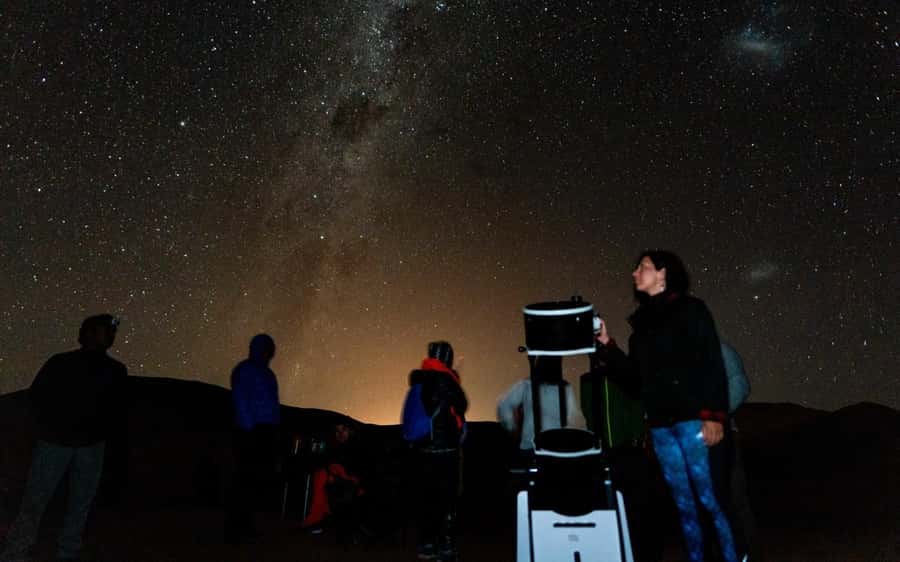
The best part of this Atacama stargazing tour is that it gives you two ways to read the same sky. An astronomy specialist explains planets, stars, galaxies, and the Southern Cross, then shifts to the Andean view, where dark spaces in the Milky Way became animals, rivers, water, calendars, and signs of life beyond death. I like that Felipe, Claudio, Salvador, and other guides make the science friendly rather than turning it into a dry lecture. I also like the chance to use the telescope yourself, instead of simply watching a guide point one at the sky.
The $41 price is excellent for 150 minutes, especially with pickup, telescope time, warm drinks, a fire, and a photo sent by email. The main catch is the cold. The desert can be brutally chilly after dark, and moonlight or clouds can reduce what you see. Check the lunar calendar, wear serious layers, and keep your schedule flexible.
Key points at a glance
- Two sky traditions: Learn Western astronomy alongside ancient Andean interpretations of the Milky Way and constellations.
- Real telescope viewing: Look for planets, binary stars, clusters, nebulae, and galaxies, depending on the season.
- Guides who explain clearly: Felipe, Claudio, Salvador, and Yvonne have led departures with strong English and Spanish explanations.
- A warm finish: End beside a fire with coffee, tea, red wine, and snacks included on the departure format.
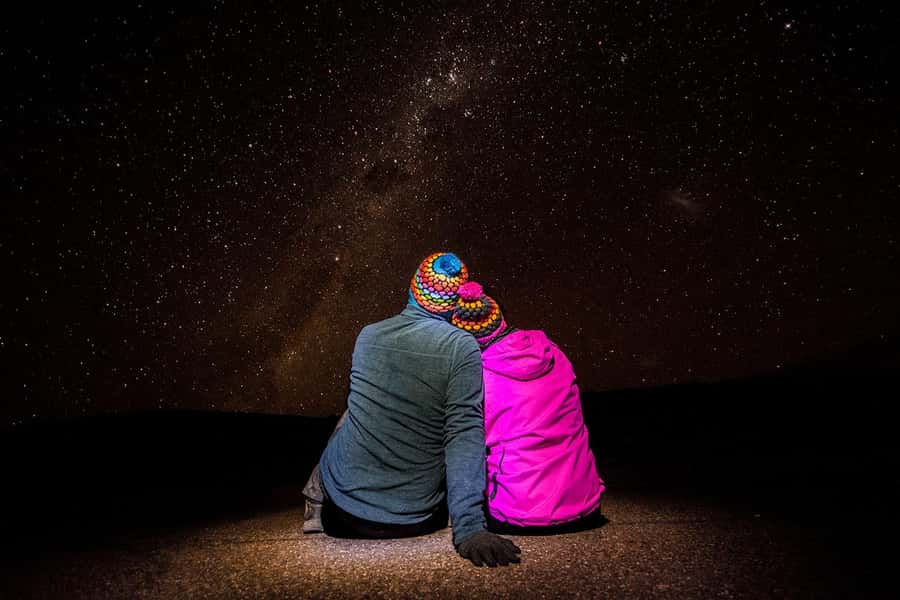
- A useful souvenir: Receive a courtesy photograph with the stars by email.
- Weather and moon matter: The start time may change, and a bright moon can make the sky less dramatic.
Why San Pedro is such a good place for stargazing
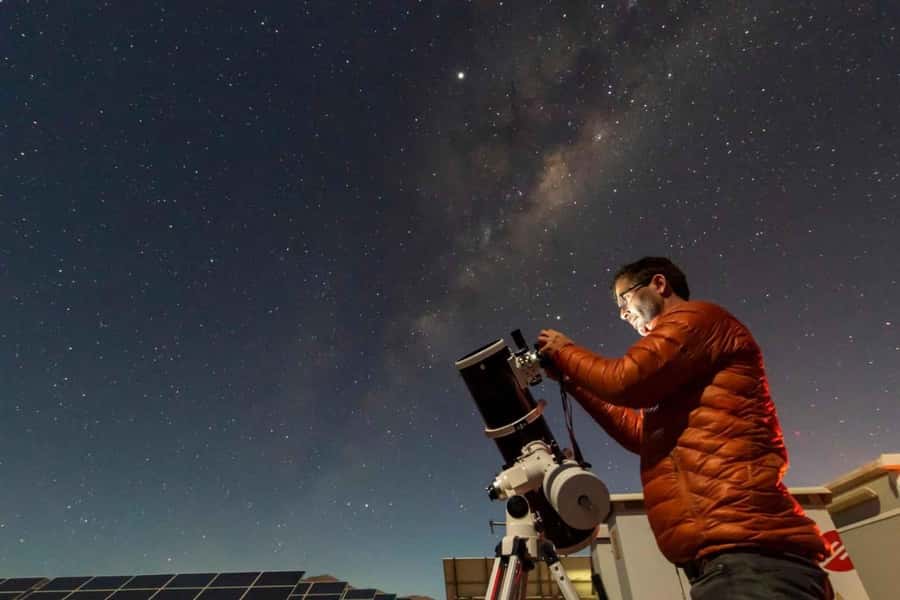
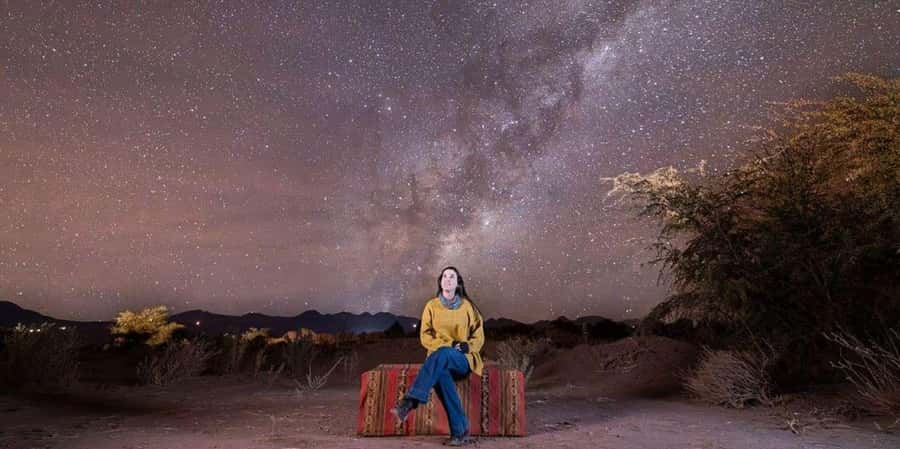
San Pedro de Atacama sits in northern Chile’s Atacama Desert, a place famous for dry air, high elevation, and very dark night skies. Those conditions matter more here than fancy presentation. When the sky is clear and the moon is modest, you can see a huge number of stars without the glow that washes out city skies.
You do not need to know the difference between a nebula and a star cluster before you arrive. The guide starts with the basics, including how astronomers think about brightness, color, planets, and the formation of the cosmos. Laser pointers help connect the spoken explanation to the actual sky above you.
The Southern Cross is a special treat for anyone from the Northern Hemisphere, since it is not visible from much of Europe or North America. Depending on the season and conditions, the telescope may also reveal Saturn, the Moon, star clusters, binary stars, nebulae, galaxies, and other solar system or deep-space objects.
The exact lineup changes. Astronomy is not a stage show with fixed scenery, so the tour cannot promise a particular planet every night. That uncertainty is part of the deal, and it is why the guide’s skill matters.
More Stargazing Tours in San Pedro de Atacama
- San Pedro de Atacama: Stargazing Experience
★ 4.7 · 489 reviews - Astronomical Tour with Guide and Pick Up San Pedro de Atacama
★ 4.5 · 145 reviews - “Astronomical Adventure in San Pedro de Atacama”
★ 4.5 · 96 reviews
From ancient Greece to the Andean night sky
The first part of the explanation follows the Western tradition. You learn how ancient Greek observers grouped stars into constellations and how modern astronomy studies the brightness and movement of celestial bodies. This gives you a familiar framework for understanding what the telescope shows.
Then the tour changes direction. Ancient Andean communities did not only connect bright stars into pictures. They also studied the dark shapes between them, especially in the Milky Way. Those dark areas could suggest animals, waterways, seasonal signs, and practical information for daily life.
That shift is one of the most worthwhile parts of the evening. It reminds you that astronomy is not just a modern science or a collection of names from Greek mythology. The night sky has long been a source of timekeeping, navigation, farming knowledge, spiritual belief, and stories about existence.
I especially like this cultural section because it gives the Southern Hemisphere sky a local meaning. You are not simply looking at unfamiliar constellations through a telescope. You are learning how people living in the Andes understood their place beneath them.
The tour description refers to a journey through ancient Greece before moving into Indigenous American interpretations. The presentation is likely to appeal most if you enjoy both science and culture. If you only want a rapid succession of telescope targets, the storytelling may feel like a longer route to the equipment. For most people, it adds needed context.
The short ride out from San Pedro
Pickup is available in San Pedro de Atacama, with the stated meeting point at Restaurant Tara on Licancabur 10. The transfer to the viewing site takes about 15 minutes, followed by a return ride of roughly 25 minutes. The exact flow can vary with the evening’s conditions.
The pickup service does not cover the ayllus, so check your accommodation location before booking. If you are meeting at Restaurant Tara, give yourself extra time to find it. One departure had difficulty locating the restaurant because the name was not familiar locally, and the guide had to look for the people waiting there.
Pickup is listed at 7 p.m. from April through August. During Chilean summer time, pickup is listed between 9 and 9:20 p.m. These late starts make sense because the sky needs to darken, but they also matter if you have an early morning excursion the next day.
The van ride is short, which is a plus after a long day in the desert. You are not spending half the night on the road. The downside is that the meeting and pickup details deserve close attention, especially if you are staying outside the central area.
What happens at the viewing site
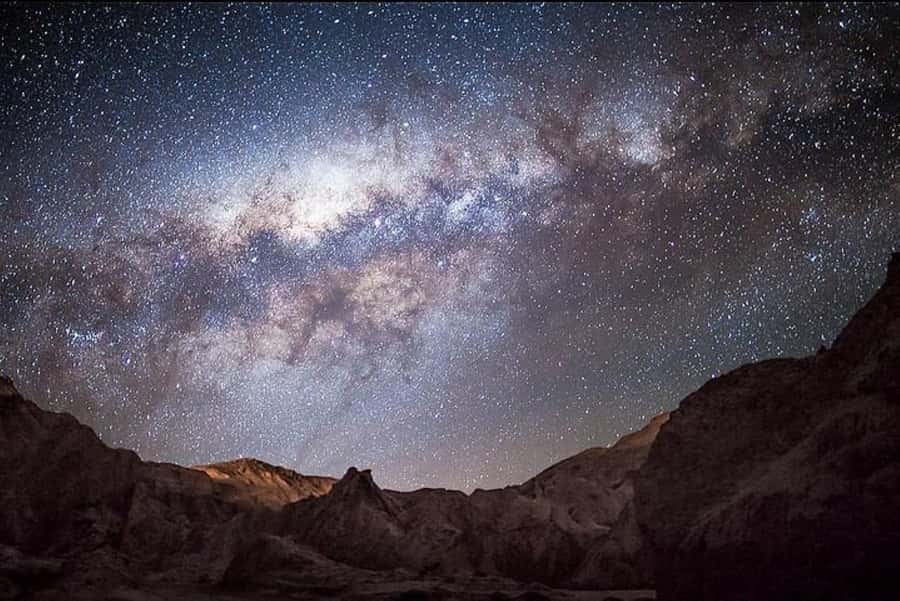
The main stop lasts about an hour and a half. You begin with an explanation of the night sky, usually seated around the viewing area, then move between naked-eye observation, photography, and telescopes.
A good guide does more than name a constellation. Guides such as Felipe and Claudio have explained why stars have different colors and brightness, how planets differ from stars, and where to look before placing an object in the telescope. That preparation makes the view more satisfying because you understand what you are seeing.
The telescope session is hands-on. You get help focusing and a chance to look through the equipment yourself. The large telescopes used on some departures have shown Saturn, Antares, the crescent Moon, star clusters, and other objects. Two telescopes may be available for a group, which can reduce waiting time, though the precise equipment and number of people can vary.
This is not an observatory visit where you remain behind a barrier. You take part in the viewing. The guide points the instrument toward an object, checks the focus, and helps you make sense of the small but striking view in the eyepiece.
Keep your expectations sensible. A telescope does not turn a galaxy into a giant, colorful poster. Some objects appear as small points or pale shapes, and the view depends on the season, weather, moon, and equipment. Even so, seeing Saturn’s rings or a cluster of stars through a telescope can be the moment that makes the whole evening worthwhile.
Same base, a completely different landscape:
- San Pedro de Atacama: El Tatio Geysers Tour
★ 4.7 · 943 reviews - Piedras Rojas, Altiplanics Lagoons & Salar Full-Day Tour
★ 4.7 · 592 reviews - San Pedro Atacama: Baltinache Lagoons
★ 4.6 · 359 reviews - San Pedro de Atacama: Valle de la Luna Guided Tour
★ 4.4 · 312 reviews
Why the guide makes or breaks the night
Astronomy can be difficult to explain in a way that holds attention outdoors in the cold. The strongest guides on this experience have been Felipe, Claudio, Salvador, and Yvonne, with visitors describing clear English, good Spanish, patience, enthusiasm, and a willingness to answer difficult questions.
Felipe has been praised for connecting current scientific research with ancient ideas. Claudio has been especially good with families, keeping children aged 10, 13, and 15 interested without burying them in technical terms. Salvador has brought an energetic, friendly manner to the presentation.
Those details matter because the sky above San Pedro is not self-explanatory. Without guidance, you may see plenty of stars but have no idea what you are looking at. A skilled guide gives you reference points, answers questions, and adapts the talk to what you want to see.
The experience is offered in English and Spanish. English explanations have been described as clear, though individual communication can naturally vary by guide and group. If you have a question, ask it. The format is informal and designed for conversation rather than silent observation.
Cold-weather planning is not optional
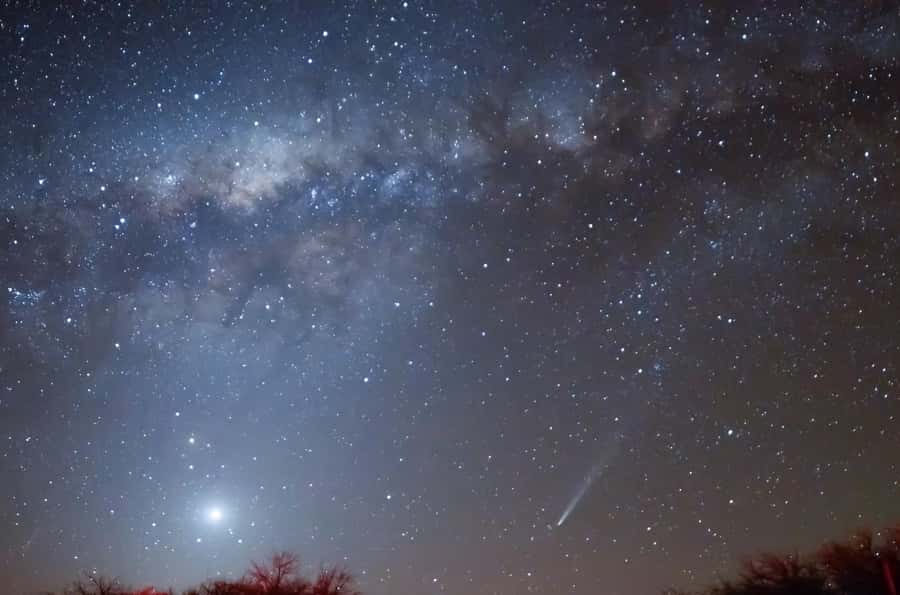
The Atacama is famous for its daytime heat, but nighttime temperatures can be a shock. You may sit or stand outdoors for much of the 90-minute viewing session, and the cold becomes more noticeable when you stop moving.
Bring warm layers, comfortable clothes, and comfortable shoes. Several departures provided ponchos or blankets, which helped, but I would still bring your own jacket and extra layer. Think winter clothing, not light desert sightseeing gear.
The tour includes coffee, tea, or red wine. Departures have also included snacks around the fire, and some formats have featured a more substantial picnic-style spread. The exact food and drink selection should not be the main reason you book, but the warm refreshment is welcome after telescope time.
Smoking, alcohol brought from outside, and drugs are not allowed. The included red wine is part of the organized refreshment service, not an invitation to treat the tour as a drinking excursion.
Binoculars are listed as an item to bring. They are not a replacement for the telescope, but they can help you scan the sky between explanations. You should also bring your passport or ID card, as requested in the practical information.
Moonlight and weather can change the plan
The lunar calendar deserves attention before you reserve. A full or nearly full moon lights the sky and can make faint stars and Milky Way details harder to see. The Moon itself can be impressive through a telescope, but the overall view will not have the same dark-sky effect.
One departure took place under a nearly full moon, and the experience remained worthwhile, but visibility was reduced. If your main goal is to see the Milky Way at its darkest, choose a night with less moonlight when possible.
Clouds and poor weather can also alter the schedule. The tour may be moved later the same night or to the following night. If conditions force a cancellation, other options are offered. You will be notified if the timing changes, sometimes on the same night.
This flexibility is sensible. A stargazing tour cannot control cloud cover, and going ahead under a cloudy sky would be a poor use of your evening. Still, do not schedule a nonrefundable late-night dinner or an early transfer too tightly around it.
Free cancellation is available up to 24 hours in advance, and you can reserve without paying immediately. Those terms are useful here because weather and moonlight make advance planning less certain.
The fire, drinks, and photographs
After the sky talk and telescope viewing, the evening often shifts to a more social finish around a fire. Coffee, tea, red wine, and snacks give you a chance to warm up and talk about what you have seen.
The fire is not just decoration. It changes the pace of the night. After concentrating on stars and telescope targets, you can sit down, warm your hands, and let the experience settle. Some departures have offered a neatly arranged snack service and wine in proper glasses rather than paper cups.
A photographer takes the included souvenir image with the stars behind you, and the photo is sent by email. The photography session has included guidance on poses and multiple attempts, rather than a rushed single snapshot. That is a useful extra at a place where ordinary phone cameras struggle to capture both people and the night sky.
There is one important moonlight note. During periods of high moonlight, the included photo may be taken only through the telescope eyepiece. That means the result can differ from the wider starry portrait you may have seen in promotional images.
You should treat the photograph as a bonus, not the core product. The sky viewing and explanations are the reason to go. Still, a good night photograph gives you something tangible after an experience that can otherwise be difficult to record.
Is $41 a fair price?
At $41 per person, this is strong value for a 150-minute evening. You receive transport within San Pedro, a specialist astronomy guide, telescope access, drinks, and a courtesy photo. Comparable activities can charge much more for a dark-sky setting and guided equipment, though prices vary widely.
The value is highest if you use every part of the experience. Listen to the sky explanation, ask questions, look through the telescope more than once if the group allows it, and take the time to study the unaided sky. If you arrive expecting only a quick photograph and one look at Saturn, you may miss what makes the tour worthwhile.
The price does not remove the normal compromises of group activities. You may wait briefly for a telescope, and the exact objects available depend on the date. The viewing site is reached by van rather than by a long remote expedition, so this is a compact San Pedro excursion, not an all-night desert camp.
Families can do well here. The explanations can be adjusted for children, and the combination of a fire, snacks, photographs, and telescope targets gives younger visitors more than one reason to stay engaged. Couples and solo visitors will also find the relaxed format easy to join.
The tour is wheelchair accessible according to the activity information. Since outdoor astronomy sites can involve uneven ground, confirm the exact access needs when booking if mobility is a serious concern.
Who should book this night under the stars?
Book it if you want a clear introduction to astronomy with a strong local connection. It suits first-time stargazers, families, curious adults, and anyone from the Northern Hemisphere who wants to see southern constellations.
It is also a good choice if you value a guide who can explain rather than simply point. Names such as Felipe and Claudio appear repeatedly in the strongest experiences, but guide assignment can change. The important thing is the format: a live specialist, questions, telescope use, and a cultural explanation of the Andean sky.
You may want another kind of activity if you dislike cold evenings, late pickup times, or schedules that can shift at short notice. A bright moon will not cancel the tour’s educational value, but it can reduce the dark-sky drama. Check the moon phase before paying, and keep the following morning free if possible.
Should you book the Etno-Stargazing Tour?
Yes, if the sky is a major reason you came to Atacama. For $41, the combination of expert explanation, telescope viewing, Andean astronomy, transport, warm drinks, a fire, and a photograph is unusually generous.
Book near a darker moon phase for the fullest effect, pack more warmth than you think you need, and confirm the Restaurant Tara meeting point if you are not using hotel pickup. If weather shifts the start time, accept the change when you can. A late clear sky is far better than an on-time evening under clouds.
FAQ
How long does the stargazing tour last?
The activity lasts 150 minutes. The itinerary includes short van transfers and about 1.5 hours at the San Pedro de Atacama viewing stop.
Where is pickup available?
Pickup and drop-off are provided in San Pedro de Atacama, excluding the ayllus. The listed meeting location is Restaurant Tara at Licancabur 10.
What time does pickup take place?
Pickup is listed at 7 p.m. from April through August. During Chilean summer time, pickup is listed between 9 and 9:20 p.m. Check the available start time for your date.
What can I see through the telescope?
Depending on the season and conditions, you may see planets, stars, binary stars, star clusters, nebulae, galaxies, and objects in the solar system. The Moon, Saturn, Antares, and star clusters have been observed on previous departures.
Is the tour available in English?
Yes. Live guides are available in English and Spanish. Guides including Felipe and Claudio have led English-language departures.
What happens if the weather is bad?
The time may be moved later the same night or to the following night. If the tour has to be canceled, other options are offered, and you will be notified.
More Private Drivers in San Pedro de Atacama
- San Pedro de Atacama: Stargazing Experience with Transfer
★ 3.5 · 8 reviews - San Pedro de Atacama: Etno-Stargazing Tour with Transfer
★ 3.5 · 5 reviews - Santiago: Concha y Toro Vineyard Tour w/ Transfer & Tasting
★ 4.2 · 455 reviews - Private Transfer from Santiago Airport to Santiago
★ 4.0 · 330 reviews
Just added around San Pedro de Atacama
- San Pedro de Atacama: Cejar Lagoon, Tebenquiche & Ojos Salar★ 3.9 · 3 reviews
- From San Pedro de Atacama: Small group to Moon Valley★ 5.0 · 3 reviews
- San Pedro de Atacama: Canyon Swimming Pools Trekking Trip★ 5.0 · 3 reviews
- San Pedro de Atacama: Rainbow Valley & Good Herbs Tour★ 4.3 · 3 reviews
- Full Desert. The most complete program you will find★ 3.2 · 3 reviews
- From San Pedro de Atacama: The Salt Flats Route, Full Day★ 3.7 · 3 reviews
- San Pedro de Atacama: Valle de la luna★ 3.0 · 3 reviews
- Valle de la Luna: A Moon-Like Escape in Atacama★ 5.0 · 3 reviews
San Pedro de Atacama Tours, compared.
Piedras Rojas, Altiplanics Lagoons & Salar Full-Day Tour
Read our review →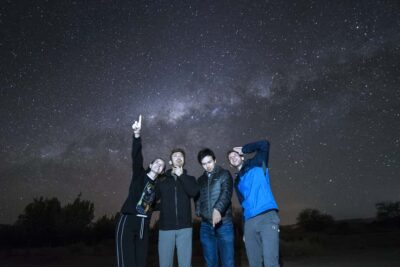
San Pedro de Atacama: 3-Day Activity Combo with 4 Tours
Read our review →
Triple tour: Red stones, highland lagoons and Chaxa Lagoon
Read our review →
Browse the lists this tour appears in